

Sunday July 12th, 2026
Environmental Follow-Up Register for Projects: How Does It Help You Demonstrate Compliance During Execution?
An environmental follow-up register is not simply a file for recording observations...
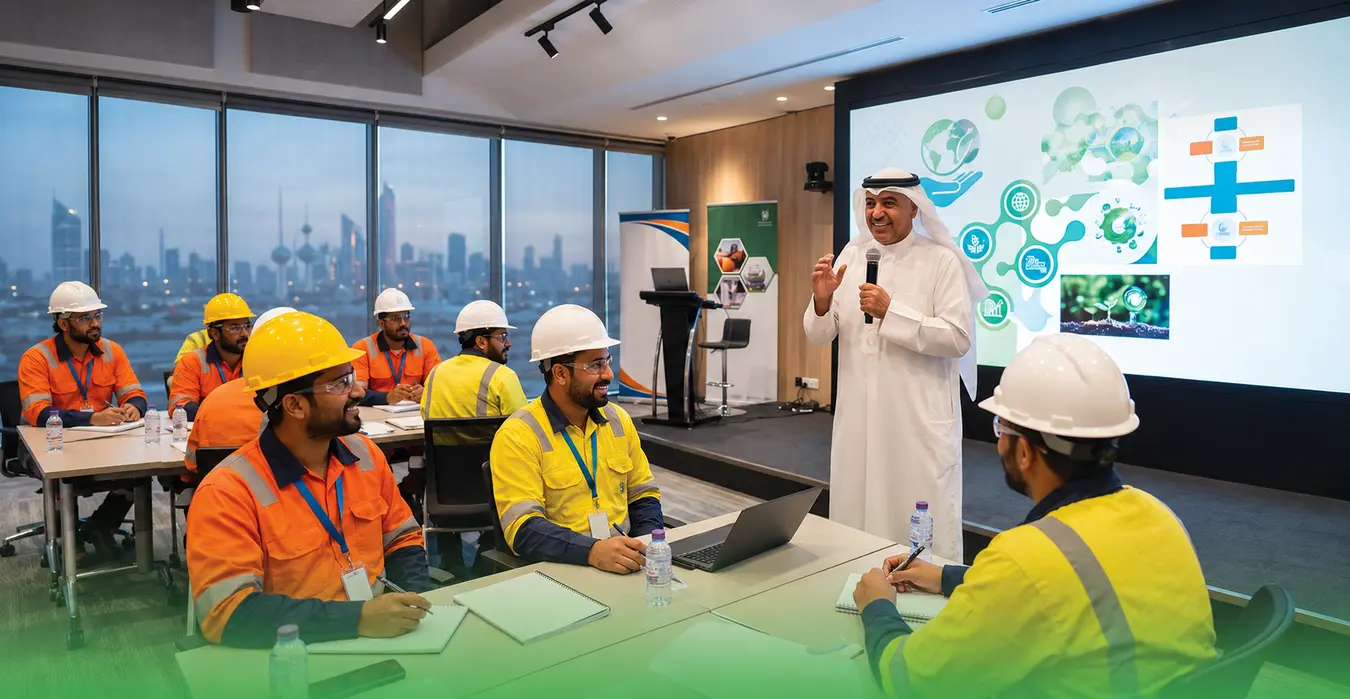
An attendance record alone does not reduce spills, waste-segregation errors, or complaints related to dust and noise. Effective training begins with the risks associated with the task and the site, explains what the worker should do before, during, and after the activity, then tests understanding and verifies behavior in the field.
For this reason, environmental training for contractors in Kuwait should be designed according to roles, languages, activities, and changes, and linked to inspections, observations, and incidents.
Make environmental training for contractors in Kuwait risk-based by identifying critical activities and worker groups, converting controls into practical messages and scenarios, providing general orientation followed by task-specific modules, testing understanding through observation or practical application, and documenting the trainer, content, attendance, and results.
After training, monitor performance through inspections and repeat training when work changes, an observation recurs, or an incident occurs.
The objective is competence and behavior, not the number of certificates issued.
It is a program based on risks, obligations, and project controls that aims to enable each category of contractor personnel to perform its work without causing uncontrolled environmental impacts.
It may include:
Not every worker needs the same level of detail.
A driver needs to understand road rules, loads, dust, and spill response.
A warehouse worker needs to understand compatibility, labeling, and containment.
A supervisor needs to understand inspection, reporting, and closure requirements.
Designing different training paths improves effectiveness and reduces wasted time.
Risks differ between:
A general presentation may cover many topics without answering the question the worker faces in a real situation:
What exactly should I do now?
Contractor personnel also change frequently, and there may be significant differences in language, experience, and working systems.
General environmental training is appropriate as an introduction to common rules, but it should be followed by training specific to the role and task.
The content should also be reviewed whenever there is a change in:
Gather the following:
Then identify:
Prioritize topics according to:
Training should never be used as a substitute for proper design, equipment, or supervision.
It should be one element within the overall control system.
Divide trainees into categories such as:
Each category should have specific learning objectives that can be observed or tested.
Avoid vague objectives such as:
“Increase awareness.”
Define:
Use a competence register showing what each person has completed and what remains required before they can be assigned to a task.
Environmental induction should cover common site rules, including:
The induction should be short, direct, and supported by photographs from the actual site.
Test understanding of critical points instead of relying on a signature.
Methods may include:
Training should explain:
Use actual samples and photographs rather than generic waste names that workers may not understand.
After training, inspect work areas and collection points and compare the types of errors occurring between different teams.
If waste mixing continues, review:
Do not assume that the training content alone is the problem.
Training should begin with:
The designated response team should be trained on:
Use scenarios involving actual materials and locations from the site.
Link the training to:
Conduct practical drills that measure:
Training should explain sources of dust associated with:
It should also cover controls such as:
Drivers and operators should know:
Monitor implementation during:
Link observations to monitoring information and complaints.
Training will not be effective if water, equipment, or an organized traffic route is unavailable.
Identify:
Supervisors should learn how to:
Workers should understand the need to avoid unnecessary equipment operation.
Use the site map and work schedule during training and connect the training to:
If equipment or its location changes, the briefing should be updated.
Training may cover:
Workers should understand the difference between water-flow routes within the site and approved discharge points according to the plan.
They should also know who to notify when:
The supervisor is the link between the management system and actual implementation.
Supervisors need deeper understanding of:
They should also be able to deliver a short briefing and verify worker understanding.
Evaluate the supervisor through real observation:
A certificate alone does not prove competence.
Use a combination of:
Consider:
Use a competent interpreter where necessary.
Terminology should be consistent with:
Avoid overcrowding slides with text.
Focus on specific decisions and ask trainees to:
Practical training is particularly suitable for skills such as:
A knowledge test may involve:
However, knowledge testing alone is not enough.
Test actual performance through:
Then monitor indicators such as:
Define:
Actions may include:
Review effectiveness again after a period of time because immediate success does not guarantee that the behavior will continue.
The training record should include:
Retain practical evidence where relevant.
Link the individual training record to:
Control revisions, prevent one person from signing on behalf of another, and protect personal information according to the organization’s system.
Analyze observations according to:
If the cause is a lack of knowledge or skill, provide targeted training.
If the cause relates to:
do not use training as the only corrective action.
After training, conduct an effectiveness check.
If the behavior recurs, perform a deeper analysis.
This connection transforms the training record from an administrative file into an improvement tool.
Retraining may be required when there is:
Retraining does not always need to be a complete course.
A short targeted module may be sufficient.
Define retraining triggers within:
Do not wait for the annual review if a new risk appears.
The Health, Safety and Environment Plan (HSE Plan) identifies risks, preventive measures, emergency arrangements, awareness, and training requirements.
The environmental training program should therefore be derived from:
It can also be linked to Environmental Supervision of Projects to verify implementation through site inspections and reports.
Site feedback should be used to update training content.
The program should not remain unchanged while:
Common mistakes include:
SSG provides training program services designed according to company requirements in:
A contractor training program can be designed by starting with:
Then developing:
The scope of the program depends on:
You can contact SSG to review your training matrix or design dedicated modules covering:
Provide:
The following can then be determined:
Once the design has been approved, a pilot version can be delivered and its results reviewed.
The full program can then be launched with:
Suppose inspections repeatedly identify contaminated containers being mixed with general waste by more than one contractor.
Before requesting another training course, the team should analyze the cause:
If the overall system is inadequate, it should first be corrected.
Training should then be designed to close the remaining knowledge or skill gap.
A short module can be prepared using photographs of actual containers and waste items from the site.
The trainer explains what the worker should do when:
Participants are then asked to segregate physical samples or cards as part of an exercise.
Anyone who makes a mistake receives:
A signature on the attendance sheet alone is not accepted as evidence of competence.
During the following two weeks, supervisors monitor waste-generation and collection points using a standardized form.
The percentage of errors before and after training is compared according to:
Short interviews are also conducted to confirm that workers understand the reason for the segregation rule rather than simply memorizing the container color.
If one team improves and another does not, review:
The subject is then incorporated into site-entry induction for new workers, and retraining is added whenever:
The results are presented at the performance meeting.
The measure of success is not how many people attended.
Instead, the focus is on:
In this way, training becomes a verifiable element within the control system rather than a paper-based reaction used merely to close an observation.
The training program review should also include feedback from trainees and supervisors, but satisfaction should not be the only measure.
A training session may be enjoyable without changing field decisions, while a short and direct session may achieve the intended result.
Feedback should therefore be combined with:
The following should also be reviewed:
The reason for any modification should be documented so that lessons learned can accumulate across different project phases and contractors.
| Category / Activity | Training Topic | Assessment Method | Evidence of Effectiveness |
|---|---|---|---|
| All site entrants | Site rules, reporting, and segregation | Questions, images, and identifying locations | Observations during the first week |
| Drivers and equipment operators | Speed, dust, spills, and inspection | Practical observation | Reduction in road-related violations |
| Warehouse and material personnel | Labeling, compatibility, and containment | Container inspection and scenario | Storage inspection results |
| Response teams | Stop, contain, communicate, and clean | Practical drill | Response time, decisions, and closure of lessons learned |
| Supervisors | Planning, inspection, briefing, and escalation | Observation during task leadership | Quality of closure and prevention of recurrence |
| Subcontractors | Task risks and contractual requirements | Test and field review | Compliance after work begins |
No.
Site-entry training provides the foundation for common rules, but it should be followed by:
By testing:
Then monitor:
Corrective action should be taken when improvement is not demonstrated.
Yes.
Requirements should apply to everyone performing work.
The main contractor should have a clearly defined responsibility for ensuring that subcontractors meet training requirements before starting their tasks.
Training should be repeated when there is:
Use:
Then ask the trainee to explain or demonstrate the required action to confirm genuine understanding.
No.
If the cause is:
the actual cause must be addressed.
Training is appropriate when there is a genuine gap in:
If your project requires an environmental review, environmental training for contractors, an environmental study, or a compliance plan in Kuwait, you can contact SSG to review the requirements and determine the appropriate scope of service according to the type of activity, stage of implementation, and competent authority.

An environmental follow-up register is not simply a file for recording observations...

A weak nonconformity report describes the problem in general terms and then...

Sorry, this entry is only available in العربية.