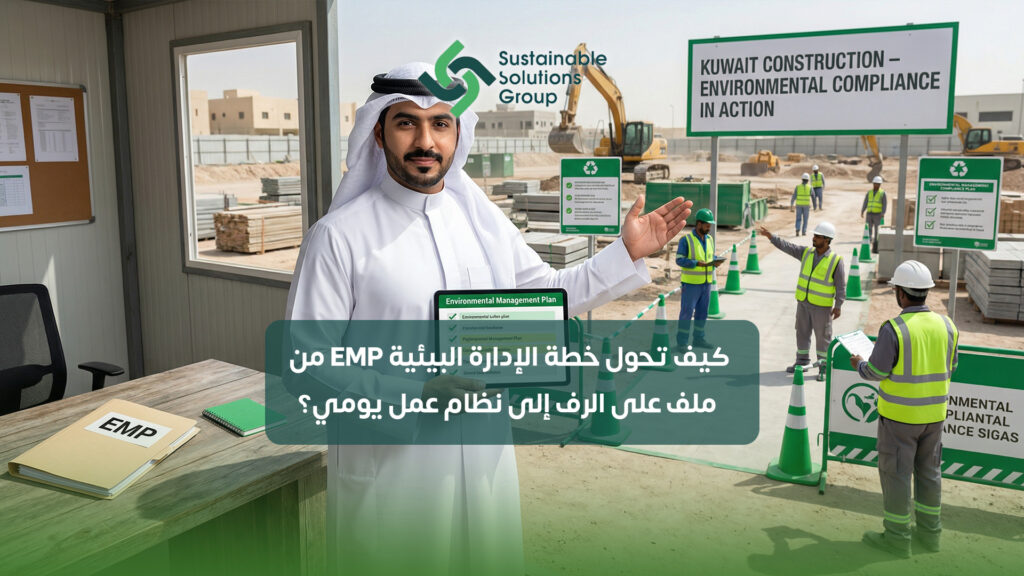
An environmental follow-up register is not simply a file for recording observations after they occur. It is a daily management tool that demonstrates that the project is monitoring its obligations and converting every observation into a clear action, responsible owner, and closure evidence.
For projects in Kuwait, a well-organized register helps connect field implementation with the Environmental Management Plan, permit conditions, and owner requirements, while preventing observations from being lost between the contractor, consultant, and site team.
The real value of the register becomes clear when the Project Manager can answer, at any time:
- What is the observation?
- Why did it occur?
- Who is responsible for addressing it?
- What evidence demonstrates closure?
Quick Answer: When Do You Need an Environmental Follow-Up Register for Projects in Kuwait?
| Practical Summary |
| An environmental follow-up register should be maintained from the beginning of site mobilization until final project closeout. It records observations, requirements, measurements, and corrective actions, while identifying the responsible person, deadline, evidence, and verification status. The more current and reviewable the register is, the easier it becomes to demonstrate compliance and reduce the risk of recurring observations or incomplete responses. |
What Is an Environmental Follow-Up Register for Projects in Kuwait?
It is a centralized paper-based or electronic register that brings all project-related environmental obligations and observations into one traceable workflow.
An observation may originate from:
- An internal inspection.
- A consultant visit.
- An owner audit.
- A monitoring report.
- A complaint.
- A document review.
The observation is then converted into a manageable action within the register rather than remaining in:
- An email.
- A photograph on someone’s phone.
- A disconnected report.
A good environmental follow-up register differs from an ordinary task list because it links every observation to its reference, such as:
- A requirement in the Environmental Management Plan (EMP).
- A permit condition.
- An internal procedure.
- A Method Statement.
- A contractual obligation.
The register also retains the history of:
- Decisions.
- Evidence.
- Revisions.
- Verification.
This allows the full sequence to be reviewed when:
- Preparing a report.
- Responding to observations.
- Discussing compliance status with management.
SSG’s Environmental Management Plan Preparation Service explains that an EMP is not limited to mitigation measures. It also includes monitoring, emergency response, waste management, and training.
The follow-up register therefore acts as an implementation tool connecting these elements to the project’s daily activities.
Why Are Environmental Observations Raised, and Why Do They Recur?
A Gap Between the Document and the Site
The environmental plan may be approved and well written, but:
- The material-storage area may not match the approved arrangement.
- The truck route may be changed.
- A subcontractor may start work without environmental induction.
In these situations, the issue is not the absence of documentation but the failure to convert the requirement into:
- Field arrangements.
- Continuous supervision.
A Quick Response That Does Not Address the Root Cause
Removing waste from one location may improve the appearance of the area, but it does not prevent recurrence if the project does not identify:
- Why the waste accumulated.
- Who is responsible for collection.
- How frequently it should be removed.
- Where containers should be located.
- How effectiveness will be verified.
An observation addressed only at the visible level will often return during the next inspection under slightly different wording.
Unclear Ownership Between Parties
When the owner, contractor, or site supervisor does not know who owns the action, the observation may move between departments.
For example:
- Construction may say the matter belongs to HSE.
- HSE may need a purchase order.
- Closure may require a layout change.
- An engineering approval may be needed.
An organized register reveals these dependencies and prevents an action from remaining without a clear owner.
Weak Evidence or Evidence That Does Not Match the Observation
An action may actually have been completed, yet closure may still be rejected because:
- The evidence is not dated.
- The location is not shown.
- The evidence does not cover all affected points.
- The observation requires a measurement rather than a photograph.
Closure evidence should therefore be considered when defining the action, not after implementation has finished.
How Should Observations Be Prioritized by Risk and Severity?
Observations should not be prioritized only according to the date they were issued.
A better approach considers:
- Severity of potential environmental impact.
- Likelihood of recurrence.
- Relationship to permit requirements.
- Impact on neighboring areas.
- Possibility of escalation during project execution.
A project may adopt four internal categories with clear definitions:
- Critical: A condition that may cause an immediate environmental impact or require the affected activity to be stopped and urgent containment initiated, such as an uncontrolled spill near a drainage system.
- High: A significant gap or noncompliance associated with an important requirement or recurring activity, requiring prompt action, a clear decision, and management follow-up.
- Medium: A deficiency that can be controlled and does not present an immediate significant impact but may recur or worsen if not addressed within the agreed timeframe.
- Low: An improvement observation or limited deficiency in housekeeping or records that should still be closed before it develops into a recurring pattern.
The classification criteria should themselves be documented.
If the rating changes because of:
- New information.
- Monitoring results.
- A complaint.
the reason for the change should be recorded.
This prevents unjustified downgrading of environmental risks and helps management direct resources toward the most important actions.
What Basic Information Should the Register Contain?
- ☐ A unique reference number for every observation, including issue date and source.
- ☐ Exact location and the activity or contractor associated with the observation.
- ☐ Objective description of what was observed, without generalization or accusatory language.
- ☐ Relevant reference, such as the Environmental Management Plan, permit, site procedure, owner requirement, or monitoring result.
- ☐ Classification, priority, and immediate containment action where necessary.
- ☐ Root-cause analysis rather than simply stating “worker negligence.”
- ☐ Corrective action, preventive action, responsible owner, and target date.
- ☐ Required closure evidence defined before implementation begins.
- ☐ Action status, such as:
- Open.
- In progress.
- Awaiting evidence.
- Awaiting verification.
- Closed.
- ☐ Name of the person who verified closure, verification date, and any later follow-up note.
Example Environmental Observation Closure Matrix
| Observation |
Root Cause |
Action |
Responsible Party |
Evidence |
Status |
| Chemical containers stored without secondary containment |
Temporary storage area was not approved before delivery |
Relocate containers, provide suitable containment, update storage layout, and brief receiving personnel |
Site Manager + HSE Officer |
Dated photos, approved layout, awareness record |
Awaiting verification |
| Construction waste accumulated near traffic route |
Collection frequency and area responsibility were not defined |
Establish collection points, transportation schedule, daily owner, and weekly inspection |
Civil Contractor |
Transport record, photographs, inspection checklist |
In progress |
| High dust levels during excavation |
Work rate changed without updating dust-control arrangements |
Increase controls, review truck route, and conduct monitoring where required |
Construction Manager + Environment Team |
Water-spraying log, photographs, monitoring results if requested |
Open |
| Missing subcontractor training records |
Work began before site-entry requirements were completed |
Stop affected activity, conduct environmental induction, and update training matrix |
Subcontractor Manager |
Attendance record, training content, understanding assessment |
Closed |
What Are Examples of Strong Closure Evidence?
Photographs and Videos
Photographs are strong evidence when they show:
- The location before the action.
- The location after the action.
- Date.
- Description.
- A clear reference point.
Avoid:
- Close-up photographs that do not establish location.
- Images that do not demonstrate the quantity or extent.
- Using an old photograph to close a new observation.
Measurements and Testing
Observations relating to:
- Air quality.
- Noise.
- Water.
- Soil.
may require measurements specifically designed to answer the relevant technical question.
SSG’s Environmental Testing and Analysis Services can be used where:
- Visual verification is insufficient.
- The Environmental Management Plan requires specific monitoring.
Records and Documents
These may include:
- Waste-transfer records.
- Delivery invoices or handover documents.
- Inspection checklists.
- Work permits.
- Maintenance records.
- Meeting minutes.
- Updated procedure revisions.
The records should be directly connected to the observation rather than being generic documents.
Independent Field Verification
In some cases, the action should not be closed simply because the person responsible for implementation uploaded evidence.
A follow-up inspection by:
- Environmental Officer.
- Environmental Consultant.
may be required to confirm that:
- The action is effective.
- The control is sustained.
- The problem has not simply been transferred to another location.
Practical Workflow From Receiving an Observation to Closing It
- Record the observation immediately with a unique reference number; do not wait for the monthly report.
- Verify the description, location, and applicable reference, and request clarification if the observation is unclear.
- Apply immediate containment where there is an existing risk or impact.
- Analyze the root cause with the team performing the activity, not only the person drafting the response.
- Define a corrective action to address the condition and a preventive action to reduce recurrence.
- Assign one clear owner for closure, even where several departments participate.
- Agree in advance on closure evidence, acceptance criteria, and target date.
- Verify implementation in the field, update the status, and attach evidence in an organized manner.
- Review recurrence during later inspections and update the plan or training where necessary.
When Do You Need Consultant Review Before Sending the Response?
Specialist review becomes more important when an observation is related to:
- An approved environmental impact assessment.
- An approved Environmental Management Plan.
- Interpretation of monitoring results.
- Changes to the monitoring methodology.
- Waste-management arrangements.
- Emergency-response arrangements.
Consultant review is also useful when the response is being submitted to:
- A regulatory authority.
- The project owner.
and the response needs to demonstrate that the root cause was addressed rather than merely showing that a temporary action was completed.
SSG can link observations to the scope of the Environmental and Social Impact Assessment or Environmental Management Plan, review the adequacy of closure evidence, and determine whether closure requires:
- Measurement.
- Verification visit.
- Document update.
SSG’s Environmental Supervision of Construction Projects can also support regular field monitoring and reporting rather than dealing with observations only at the end of the reporting period.
Common Mistakes to Avoid
- Using general statements such as “corrected” without explaining what changed, where, and when.
- Closing an observation using one photograph that does not demonstrate the location or sustainability of the action.
- Assigning several responsible persons without one clear action owner.
- Treating training as the automatic solution to every problem even when the root cause relates to planning or resources.
- Repeatedly extending the due date without escalation or documented justification.
- Separating the observation register from the Environmental Management Plan and monitoring reports.
- Sending the response without checking attachments and confirming that observation numbers match the supporting evidence.
How Can SSG Help?
SSG, as an environmental consultancy in Kuwait, can help transform a collection of observations into a reviewable closure process.
The work begins by understanding:
- Source of each observation.
- Applicable reference.
- Project stage.
The team then reviews:
- Root cause.
- Proposed action.
- Closure evidence.
and identifies gaps that may:
- Cause recurrence.
- Delay acceptance of the response.
This does not mean guaranteeing approval. The purpose is to improve the technical and organizational quality of the closure package and provide the project team with clearer outputs.
Steps to Request the Service From SSG
- Send the observation register or review letter together with the latest Environmental Management Plan.
- Explain the project status, contractors, ongoing activities, and required internal deadlines.
- Compile available evidence, including photographs, measurements, records, reports, and relevant correspondence.
- SSG reviews the observations, classifies the gaps, and proposes the appropriate scope.
- Conduct a site visit, desktop review, or ongoing monitoring program according to project needs.
How Can the Register Be Used in Management Meetings and Reports?
The environmental follow-up register should not remain a tool used only by the Environmental Officer.
It can be converted into a weekly management decision dashboard showing:
- Number of open observations.
- Overdue actions.
- Items requiring additional resources.
- Items requiring approval.
- Items requiring subcontractor intervention.
The meeting should focus on:
rather than reading every line of the register.
In this way, the register becomes a tool for directing:
- Project execution.
- Budget.
- Resources.
rather than simply an attachment to the monthly report.
When preparing periodic reports, the register can be used to identify trends such as:
- Areas with the most recurring observations.
- Contractors with the highest number of observations.
- Most common root causes.
- Average closure duration.
- Percentage of observations that recur after closure.
This analysis helps determine whether the underlying problem relates to:
- Individual behavior.
- Planning.
- Procurement.
- Supervision.
- Site design.
It is also useful to link observations to:
- Project activity.
- Project phase.
For example, increased dust observations during excavation may be expected but may require additional resources.
However, if the same problem continues after excavation is complete, it may indicate a different weakness.
Linking the data with the construction schedule helps management interpret trends and avoid comparing dissimilar project periods.
Practical Performance Indicators That Can Be Extracted From the Register
- Percentage of observations closed within the agreed internal deadline.
- Average closure time by risk level and contractor type.
- Number of observations recurring after closure verification.
- Percentage of actions requiring extensions or additional resources.
- Most frequent root causes during the month or project phase.
- Percentage of observations closed with complete evidence on the first review.
These indicators should not become superficial targets that pressure the team to close cases quickly without ensuring effectiveness.
Closure quality is more important than the number of cases closed.
It is therefore advisable to:
- Review a sample of closed observations.
- Verify that controls remain effective.
- Reopen an observation if the evidence proves insufficient or the root cause was not addressed.
Frequently Asked Questions About Environmental Follow-Up Registers for Projects in Kuwait
What Is the Difference Between an Environmental Follow-Up Register and a Periodic Monitoring Report?
The register is a continuously updated operational tool used to track:
- Observations.
- Actions.
- Responsibilities.
- Evidence.
on a day-to-day basis.
A periodic monitoring report is a formal or management deliverable summarizing:
- Compliance status.
- Monitoring results.
- Actions.
during a defined period.
The register is often one of the primary sources used to prepare the periodic report.
Who Is Responsible for Updating the Environmental Follow-Up Register?
A clear person should be assigned to manage the register.
This is often:
- Project Environmental Officer.
- Project HSE Officer.
Contractors and departmental representatives should provide:
- Evidence.
- Action updates.
Final approval of closure remains with the person or party defined in:
- Environmental Management Plan.
- Project management system.
What Is the Strongest Evidence for Closing an Environmental Observation?
There is no single form of evidence suitable for every case.
Evidence may include:
- Dated photograph.
- Waste-transfer record.
- Monitoring result.
- Training record.
- Updated procedure.
- Field-verification report.
The strength of the evidence comes from its direct relationship to the observation and its ability to demonstrate that the cause and required action have been properly addressed.
Are Photographs Enough to Close All Environmental Observations?
No.
Photographs are suitable for visually verifiable conditions such as:
- Storage-area arrangement.
- Installation of barriers.
However, photographs alone cannot demonstrate:
- Air quality.
- Wastewater quality.
- Training effectiveness.
Some cases require:
- Measurements.
- Records.
- Laboratory results.
- Independent verification.
When Should an Environmental Observation Be Escalated to Management?
Escalation is recommended when the observation:
- Is high risk.
- May affect a permit.
- May affect neighboring areas.
- Recurs despite corrective actions.
- Requires resources or management decisions.
- Cannot be closed within the agreed deadline.
Early escalation helps prevent risks from accumulating.
When Do You Need an Environmental Consultant to Review the Closure Package?
Consultant review may be appropriate when observations are:
- Related to an environmental study.
- Related to a permit.
- Related to an approved Environmental Management Plan.
- Dependent on specialist measurements.
- Recurring due to weak root-cause analysis.
- Being formally resubmitted to a regulatory authority or project owner.
Start Reviewing Your Project Register With SSG
If your project is facing recurring environmental observations or requires an organized closure package, SSG can review the environmental follow-up register and link every observation to the appropriate action and supporting evidence.
You can contact SSG to define the review scope according to the project stage, activity type, and applicable environmental requirements.