Tuesday May 12th, 2026
(العربية) الفرق بين النفايات الخطرة وغير الخطرة: لماذا يغيّر التصنيف طريقة التخزين والنقل؟
Sorry, this entry is only available in العربية.


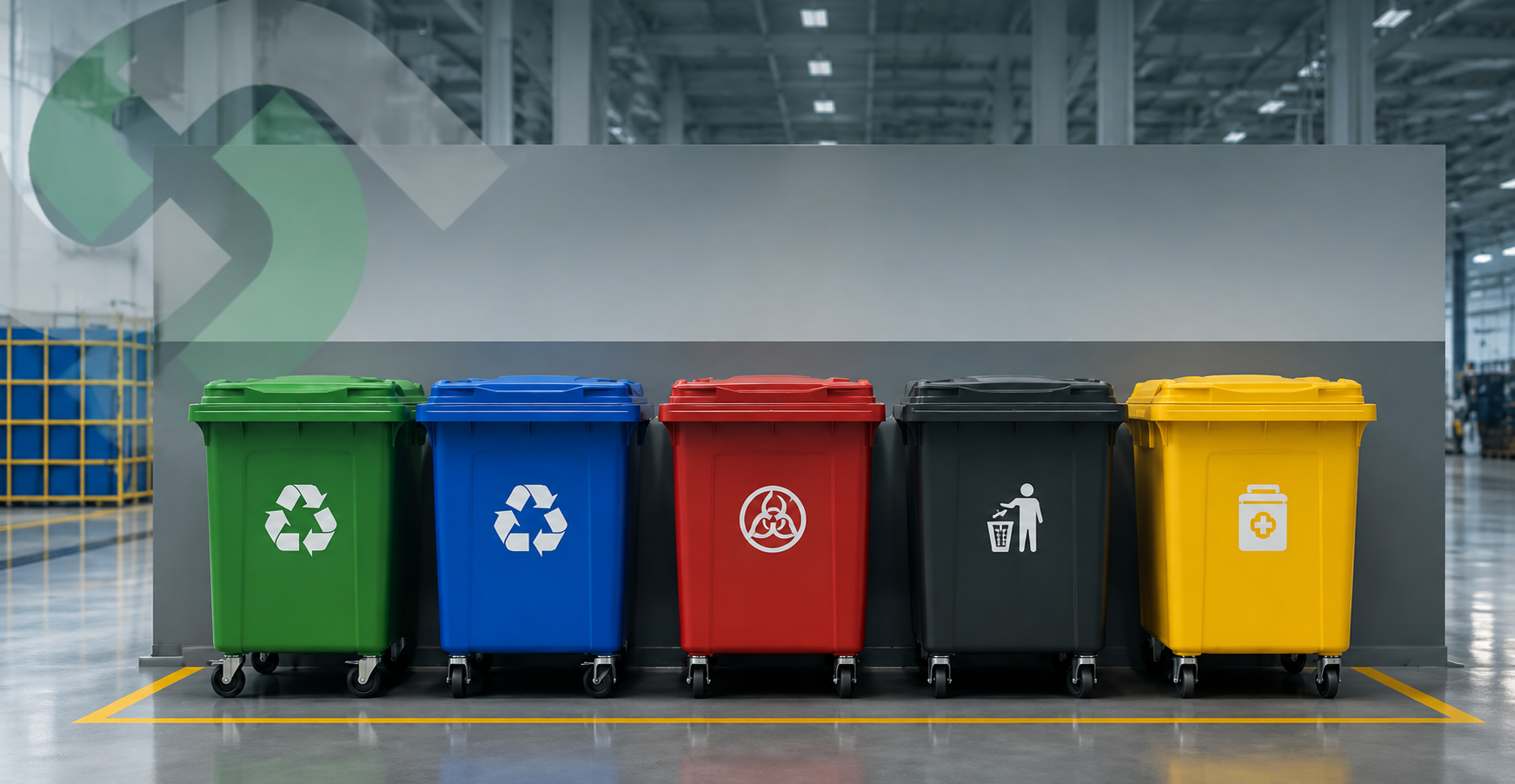
Choosing the waste container location within a facility in Kuwait is not simply about finding the nearest available empty space. It depends on the type and quantity of waste, employee movement routes, collection and transportation methods, proximity to food areas, entrances, and sensitive zones, as well as the ability to clean the area and prevent leaks and odors. Therefore, the appropriate container location should support daily operations while also contributing to organized environmental management.
There is no single location that is suitable for every facility. Waste containers in a shopping mall are different from those in a factory, hotel, warehouse, or food establishment. The correct decision starts with identifying waste-generation sources, then determining waste categories, capacities, collection points, and the route from those points to temporary storage or to the party responsible for transportation and final handling.
Quick Answer: Why Is It Important to Organize Waste Container Locations for Projects and Facilities in Kuwait?
Proper organization of waste container locations helps reduce waste accumulation, odors, and leaks, improves segregation at source, facilitates the work of cleaning and transportation teams, and reduces the likelihood of waste being placed in corridors or undesignated areas.
It also allows facility managers and operations personnel to monitor contractor performance more effectively, because each area becomes linked to specific containers, an emptying schedule, and a person responsible for inspection and cleaning.
This becomes even more important when a facility generates several types of waste, receives large numbers of employees or customers, or operates around the clock.
Quick Answer: When Does a Project Need Environmental Consultancy in Kuwait?
Environmental consultancy can be useful when the facility does not know the appropriate number or locations of containers, when overflowing, leaks, odors, or waste mixing occur repeatedly, or when the existing collection system no longer matches the expansion of the activity.
A review also becomes important when establishing a new facility, adding production lines, changing the cleaning company, redesigning service areas, or updating the Environmental Management Plan.
Requirements vary according to the sector, facility size, location, types of waste, and competent authorities. Therefore, the scope of work should be determined after reviewing the details of the activity rather than relying on one standard model.
What Is Meant by Organizing Waste Container Locations Within a Facility?
It means designing a system that determines where each container should be placed, what it should receive, who should use it, when it should be emptied, and how waste moves from the container to the next stage.
The system may include three levels:
Level One: Containers Close to Waste-Generation Sources
Such as:
Level Two: Internal Collection Point
This receives waste from several departments before it is transferred to a larger area.
Level Three: Temporary Storage Area
Waste is collected and organized there before being handed over to the contractor or the party responsible for transportation, treatment, or disposal according to the type of waste and the approved site arrangements.
SSG’s waste management service explains that management plans address the classification of waste types, identification of temporary storage locations, source-segregation mechanisms, transportation arrangements, and appropriate handling methods.
Why Is the Container Location Both an Environmental and Operational Decision?
An unsuitable location may seem like a minor issue at first, but it can create a chain of problems.
If the container is too far from the waste source, workers may leave bags at the nearest available point.
If it is too close to customer entrances, problems related to appearance or odors may arise.
If it is located along equipment movement routes, it may be damaged or obstruct operations.
If it is next to raw materials, food, or clean areas, the facility may need to reassess segregation and movement routes.
If it is located in an area that collection vehicles cannot easily access, manual handling may increase or collection delays may occur repeatedly.
Therefore, selecting the location should combine:
Ease of use + segregation + cleanliness + safety + ease of transportation + ease of monitoring.
What Types of Waste Should Be Identified Before Distributing Containers?
Before selecting any location, identify the waste that is actually generated.
This may include:
Having several waste types does not necessarily mean that a separate container must be placed for every material at every collection point.
It may be more practical to establish a limited number of segregation points at the main generation sources and then transfer the materials to a more detailed central area.
The Kuwait Environment Public Authority includes within its executive regulations provisions concerning the management of hazardous, medical, municipal solid waste, and sludge, in addition to separate regulations covering waste transportation and environmental management. This confirms that the same handling method does not apply to all types of waste.
Where Should Waste Containers Be Placed Within a Facility?
The practical principle is to minimize the distance between the person generating the waste and the appropriate container without placing the container where it interferes with movement.
For example, if a packaging area generates large quantities of cardboard, it would not be practical to require a worker to carry the cardboard to the opposite side of the facility several times per hour.
A nearby cardboard collection point can be designated, with the cardboard then transferred according to a defined schedule to the central area.
The container or surrounding waste bags should not become an obstruction in:
The location should also be reviewed after actual operations begin, because a point that appears suitable on a drawing may become congested during peak hours.
The container area should allow for regular cleaning.
It is useful to review:
Organic or wet waste requires more frequent management than dry cardboard.
It may therefore be necessary to:
If a worker has to cross stairs, narrow corridors, or congested areas to reach a container, compliance with the system becomes more difficult.
The entire route should be assessed:
Source → Container → Collection Point → Temporary Storage → Vehicle or Transporting Party.
Containers placed beside forklift or vehicle routes may be struck and damaged.
Likewise, placing them in an area exposed to hot work or other hazards requires review according to the nature of the activity.
If containers or temporary storage areas are located outdoors, consider:
Is There a Fixed Distance That Must Be Maintained Between Containers and Buildings?
It is not advisable to use one number as a general rule for all facilities.
The appropriate distance depends on factors such as:
Therefore, the actual situation should be reviewed rather than applying a distance taken from another project whose circumstances may be completely different.
How Do You Select the Size and Number of Containers?
One of the most common mistakes is choosing the container size before measuring the amount of waste generated.
Start by asking:
How Much Waste Is Generated Daily?
A survey can be conducted for one week or longer depending on variations in operations.
Record:
What Is the Collection Frequency?
One large container emptied daily may be less suitable than two smaller containers distributed close to different sources, or vice versa.
Are There Seasonal or Operational Variations?
In shopping malls and hotels, quantities may change according to occupancy and events.
In industrial facilities, waste volumes may increase during a particular production or maintenance campaign.
Is the Container Actually Full, or Is It Being Used Incorrectly?
Capacity may appear insufficient when the real problem is that cardboard is not being flattened or a general waste container is receiving materials that could have been segregated.
How Do You Segregate Waste Within the Facility?
Good segregation begins at the source.
Clear categories may be adopted, such as:
However, a large number of containers should not be introduced if the facility does not have a clear route for what happens to each category after collection.
Segregation inside the facility loses its value if the materials are mixed again during transportation.
Use Clear Labels
Write:
Place Here:
Specific examples.
Do Not Place Here:
Examples of common mistakes.
Images are often easier for workers to understand than long written instructions.
Review the Colors Used
Colors can be helpful, but they should not be relied upon alone.
The name of the waste category should be clearly visible.
Monitor the Contamination Rate
If the cardboard container contains food bags every day, there is a problem.
The reason may be:
How Do You Prevent Odors and Leaks Around Containers?
Do Not Wait Until the Container Is Completely Full
Overfilling leads to:
An internal collection threshold can be established, such as emptying the container when it reaches a defined level rather than waiting until waste begins spilling out.
Monitor the Bags Being Used
They should be suitable for:
Clean the Container Itself
Cleaning the floor alone is not sufficient.
Waste residues may stick to the sides or lid of the container and continue producing odors even after the container has been emptied.
Inspect Damaged Containers
Look for:
A container should be repaired or replaced when it can no longer perform its intended function properly.
How Do You Organize the Temporary Storage Area?
The temporary storage area is not simply a place where large containers are positioned.
Consider:
Segregation of Waste Types
Avoid placing all categories together in one area without identification.
Ease of Access
Operations and transportation teams should be able to access the area without moving waste over unnecessary distances.
Preventing Accumulation
Establishing an operational capacity limit helps ensure collection is requested before the area becomes overcrowded and disorganized.
Cleanliness
Assign clear responsibility for:
Signs and Identification
A new worker or contractor should be able to identify where each material belongs without relying on memory.
SSG’s waste management service highlights the importance of identifying temporary storage areas, source-segregation mechanisms, and appropriate handling and transportation methods according to waste classification.
Daily Waste Container Monitoring Template
The following table can be used by the facility manager or cleaning supervisor:
| Inspection Item | Required Condition | Action if a Problem Exists |
|---|---|---|
| Fill level | Within operational capacity | Request emptying or revise the schedule |
| Container lid | Intact and closes when required | Repair or replace |
| Bags around the container | None present | Remove them and identify the cause of accumulation |
| Floor | Clean and as dry as reasonably possible | Clean and inspect the source of leakage |
| Odors | No abnormal odor problem | Empty, clean, and review the source |
| Segregation | Materials placed in the correct container | Repeat awareness training and correct labels |
| Labels | Clear and intact | Replace them |
| Container | No cracks or leaks | Repair or replace |
| Access | Route is unobstructed | Remove obstructions |
| Pest control | No concerning indicators | Address the cause according to the approved system |
| Collection time | Completed according to plan | Contact the contractor |
| Photographs | Document important conditions | Attach them to the monitoring record |
Who Is Responsible for Monitoring the Containers?
Responsibility should not be defined generally as “the cleaning department.”
It is preferable to assign specific roles.
Worker or User
Responsible for placing waste in the correct container.
Cleaning Worker
Responsible for internal collection and identifying overflow or leakage.
Supervisor
Responsible for conducting the daily inspection and recording observations.
Facility or Operations Manager
Responsible for reviewing recurring problems, capacity, and collection schedules.
External Contractor
Responsible for the services specified in the contract, such as collection or transportation at agreed times.
Environmental Officer
Reviews performance from an environmental management and compliance perspective and determines whether corrective action or plan updates are required.
How Do You Measure the Performance of the Container System?
Do not make the only indicator:
“Is the site clean right now?”
Use indicators such as:
After two or three months, clear patterns may become visible.
For example:
If the same container becomes full every day two hours before the scheduled collection time, the solution is not simply to continue recording the observation. Capacity should be increased, the collection time changed, or an additional collection point introduced.
When Should a Container Be Moved From Its Current Location?
There are several indicators that justify reassessment:
Do not assume that a container must remain in the same location simply because it has been there since the facility opened.
How Do You Manage the Cleaning Company or Waste Collection Contractor?
The contract alone does not guarantee that the system will succeed.
There should be clear operational expectations.
These may include:
Monitor What Happens After Waste Leaves the Area
If the facility separates cardboard and plastic, the next stage should also be understood.
The Kuwait Environment Public Authority places importance on waste data management, including quantities, composition, transportation, treatment, and disposal methods, as part of efforts to develop the waste management system in the country.
What Are the Risks of Selecting an Unsuitable Waste Container Location?
Increased Operational Risks
Containers placed in corridors or movement areas may obstruct workers and equipment.
Poor Site Cleanliness
A location that is difficult to reach or clean may gradually become an accumulation point.
Increased Odors
Wet or organic waste that remains for extended periods may create noticeable problems for users.
Mixing of Waste
Containers that are too far away or poorly labeled may cause people to use the nearest container regardless of the type of material.
Higher Collection Costs
An impractical container distribution system may increase the time and labor required for waste collection.
Difficulty Achieving an Appropriate Level of Environmental Compliance
When designated locations, monitoring records, and clear responsibilities are absent, it becomes more difficult to demonstrate that an effective waste management system exists.
Increased Risk of Leakage or Contamination
A damaged container or unsuitable location may allow liquids or material residues to spread into surrounding areas.
Impact on Customer Experience
In commercial facilities and hotels, exposed or overflowing containers near public areas also affect operational quality and the overall appearance of the premises.
Common Mistakes in Waste Container Distribution
Placing the Container in the Nearest Empty Space
The available space may be far from the source of waste or located along an equipment route.
Using One Container for Everything
This makes segregation at source more difficult.
Increasing the Number of Containers Without a Plan
Having ten categories is not useful if workers do not understand how to use them or if the materials are mixed again later.
Failing to Use Clear Labels
Container color alone may not be sufficient.
Continuing to Use the Same Container Despite Changes in Operations
When a facility expands, the capacity, type, and location of containers should be reviewed.
Ignoring the Area Behind Containers
Small pieces of waste or liquids may accumulate in locations that are not visible during a quick inspection.
Failing to Record Repeated Overfilling
If a container becomes full every day, the problem requires corrective action rather than repeated cleaning alone.
Failing to Train Cleaning Companies
Contractor workers need to understand the same segregation system followed by the facility.
When Does a Facility Need a More Comprehensive Waste Management Plan?
Redistributing containers may be sufficient in some facilities.
However, a facility may require a broader plan when:
SSG Environmental Management Plans include prevention and mitigation measures, monitoring and follow-up mechanisms, waste management, training, and awareness, allowing the container system to be incorporated into a broader management framework.
A facility can benefit from Environmental Management Plan Preparation when it needs to connect containers with operating procedures, responsibilities, and monitoring rather than simply redistributing them.
What Should Be Reviewed Before Requesting Environmental Consultancy?
Use this checklist before assessing the container system:
Practical Table to Help You Choose the Appropriate Environmental Service
| Facility Situation | Appropriate Service | Objective |
|---|---|---|
| New facility | Waste Management Plan | Determine containers, locations, and routes before operation |
| Shopping mall | Collection point review | Organize waste from shops and public areas |
| Factory | Waste classification and assessment | Segregate waste types according to operations |
| Hotel | Operational Waste Management Plan | Organize waste from rooms, kitchens, and service areas |
| Containers constantly overflowing | Capacity and collection review | Prevent accumulation |
| Recurring odors | Location and cleaning assessment | Identify the cause and appropriate action |
| Poor segregation | Segregation and training program | Improve the quality of separated materials |
| Multiple contractors | Management and monitoring plan | Clarify responsibilities |
| Expanded facility | Environmental Management Plan update | Align the system with the new scale |
| Lack of data | Waste monitoring program | Measure quantities and improve decision-making |
How Do You Choose an Environmental Consultancy Company in Kuwait?
Experience With the Type of Facility
A container system in a factory differs from one in a hotel, shopping center, or warehouse.
The consultant should understand operational flows and waste-generation sources.
Understanding of Kuwaiti Requirements
The system should be reviewed in the context of the Environmental Protection Law, its executive regulations, and the requirements applicable to the relevant activity and waste types.
The Environment Public Authority is the government authority responsible for environmental affairs in Kuwait, and the environmental framework is based on Environmental Protection Law No. 42 of 2014, as amended by Law No. 99 of 2015.
Ability to Conduct a Site Inspection
Site photographs are useful, but a field inspection reveals:
Clear Methodology
The outputs should be practical and applicable.
For example:
Understanding Waste Management, Not Just Container Purchasing
The problem is not always the type of container.
The problem may be:
Ability to Integrate the System Into the Environmental Management Plan
If the facility is larger or more complex, the waste management system should become part of the overall environmental management system.
How Can SSG Help You Organize Waste Containers and Manage Facility Waste?
The SSG team can review the existing waste management system and identify suitable improvements according to the nature of the activity.
Support may include:
SSG’s Solid and Liquid Waste Management Service explains that the scope of work includes classifying waste types, determining appropriate handling methods, temporary storage, segregation at source, and transportation, as well as preparing, implementing, and monitoring Waste Management Plans within facilities.
This methodology helps move from the question:
“Where should we place the container?”
to a broader system that answers:
What goes into the container? Who inspects it? When is it emptied? Where does the waste go? And what action is taken when a problem repeatedly occurs?
Steps to Request Environmental Consultancy From SSG
Send a brief description of the facility and the current problem.
For example:
You may share:
Waste-generation sources, locations, and movement within the facility are identified.
The review covers:
The facility may require:
Actions are prioritized according to urgency and operational feasibility.
A follow-up review can be conducted to verify:
Frequently Asked Questions About Waste Container Locations Within a Facility in Kuwait
Where Should the Waste Container Location Within a Facility in Kuwait Be Selected?
Containers should be close enough to waste-generation sources to make them easy to use, while ensuring that they do not obstruct corridors, emergency exits, or equipment movement. The type of waste, ease of cleaning the area, and accessibility for collection teams should also be considered. There is no single location suitable for all facilities. The appropriate location is determined after reviewing operations, movement routes, sensitive areas, and storage and transportation methods.
Is There a Fixed Distance Between a Waste Container and a Building?
It is preferable not to rely on one general distance for all situations. The required spatial separation varies according to the type of waste, container type, collection frequency, nature of the building, neighboring areas, and applicable requirements. A container for dry cardboard is different from one receiving wet waste. Therefore, each location should be assessed according to its operational and environmental risks rather than using a distance taken from a different facility.
How Do I Determine the Number of Containers a Facility Needs?
Start by measuring waste quantities and fill rates in each area over a period representative of normal operations. Monitor peak hours, collection frequency, and waste types. The appropriate capacity and number can then be determined. If a container constantly becomes full, this does not necessarily mean that a larger container must be purchased. Increasing collection frequency, segregating cardboard, or changing the distribution of collection points may be more appropriate.
How Can We Prevent Odors Around Waste Containers?
The facility needs to combine adequate capacity, suitable emptying frequency, container closure when required, cleaning of both containers and floors, leakage prevention, and avoiding leaving bags outside containers. The type of waste causing the odor should also be identified. If the problem continues despite cleaning, the location, collection frequency, or container type may be unsuitable and a broader operational review may be required.
Should All Waste Be Segregated Within the Facility?
The level of segregation depends on the types and quantities of waste and the facility’s ability to manage each stream after collection. It is better to create clear categories that workers can actually apply than to install a large number of containers without a system. It should also be confirmed that segregated materials are not mixed again later. Some waste types may require different arrangements depending on their nature and applicable requirements.
How Often Should Waste Containers Be Inspected?
Inspection frequency depends on waste quantity and type, operating hours, and the level of use in the area. High-use areas or organic waste may require several inspections during the day, while other areas may require less frequent monitoring. The important point is to inspect containers before they reach an overflowing or accumulated condition and to record recurring problems so they become corrective actions rather than simply repeated cleaning tasks.
Is Waste Container Management the Responsibility of the Cleaning Company Only?
No. The cleaning company may carry out collection and cleaning, but facility management must determine container locations, waste categories, responsibilities, monitoring schedules, and contractor performance requirements. Employees must also understand how to segregate waste and report problems. The success of the system depends on coordination between facility management, operations, environmental personnel, the cleaning company, and the party transporting the waste.
When Does the Waste Container Location Within a Facility in Kuwait Require a Consultancy Review?
A consultancy review can be useful when overflowing, odors, leaks, or waste mixing occur repeatedly, when the facility expands and operational routes change, or when it becomes difficult to determine appropriate capacities and locations. It is also useful when preparing a new Waste Management Plan or updating the Environmental Management Plan. The assessment begins by identifying waste types, generation sources, and collection routes before proposing changes to locations or containers.
Contact SSG for Environmental Consultancy
If your facility is experiencing overflowing containers, poor segregation, odors, or difficulty selecting the appropriate waste container location within a facility in Kuwait, you can contact SSG for an initial assessment of your project requirements. SSG provides direct communication channels for environmental consultancy and service requests in Kuwait.
The initial assessment can help determine whether the facility needs container redistribution, changes to capacities and schedules, the design of a segregation system, or the preparation of a comprehensive Waste Management and Environmental Management Plan.
Sorry, this entry is only available in العربية.
The environmental success of an industrial facility begins before equipment is purchased...

When a client or tender requests environmental data for a product, sending...