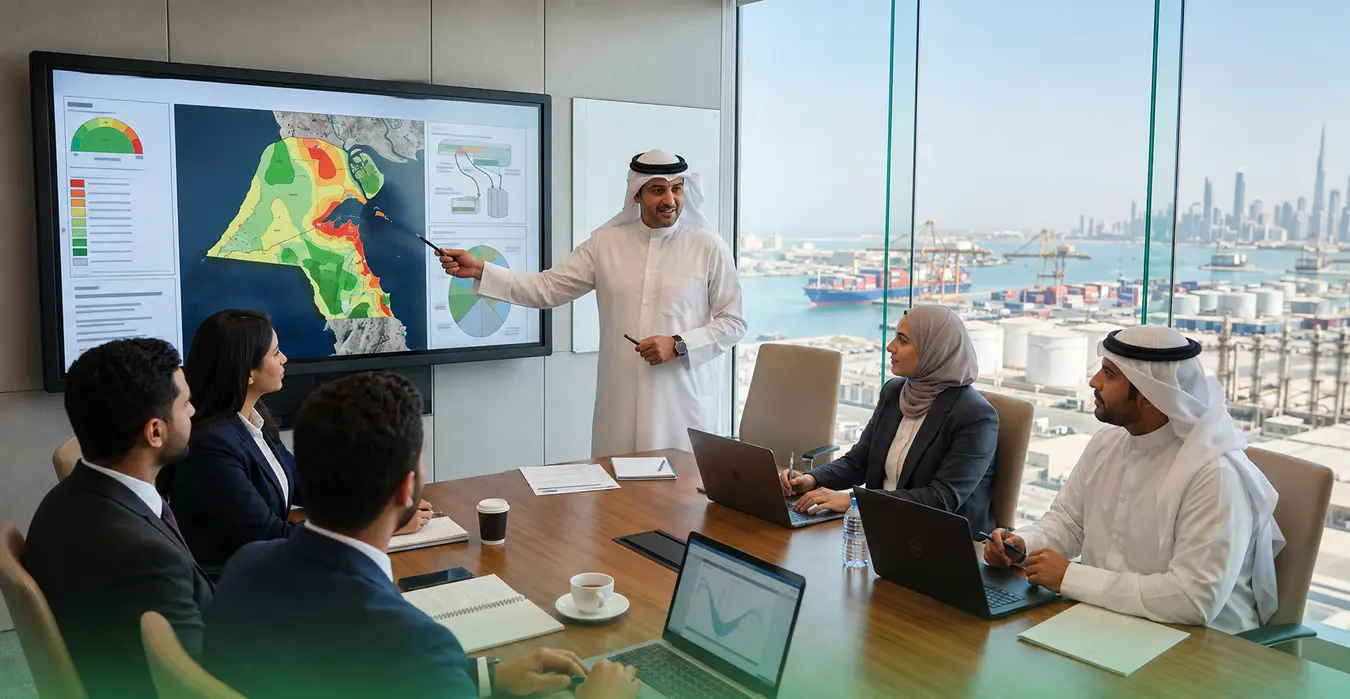
The quality of an environmental approval application begins before the first page of the study is written.
If information about the site, process, production capacity, or implementation schedule is incomplete, the project team may be forced to make assumptions, and inconsistencies may emerge between documents provided by the owner, contractor, and consultant.
For this reason, an Environmental Approval Checklist in Kuwait is a practical tool for collecting information from its original source, assigning responsibility for each item, and checking consistency before the application package is submitted.
The objective is not to collect the largest possible number of documents, but to collect the correct information that can actually be used for impact assessment and decision-making.
Quick Answer: When Do You Need an Environmental Approval Checklist in Kuwait?
| Practical Summary |
| A checklist should be prepared as soon as the project or expansion concept is defined and before submitting the application or approving the study scope. The checklist gathers information about the owner, site, activity, equipment, materials, capacity, waste, emissions, contractor arrangements, and implementation schedule. Missing information and inconsistencies should then be reviewed before the final version is prepared, helping reduce unnecessary requests for additional information. |
What Is an Environmental Approval Checklist in Kuwait?
It is an organizational tool that divides data requirements into clear categories and identifies:
- The source of each item.
- Its current status.
- Its revision or version.
The checklist does not mean that every project requires every item at the same level of detail.
Instead, it helps:
- Prevent important information from being forgotten.
- Identify whether the project is still at a preliminary concept stage.
- Determine whether the project is ready for a more detailed assessment.
SSG’s Environmental and Social Impact Assessment service explains that assessment normally includes:
- Defining the project.
- Collecting baseline data.
- Reviewing the regulatory framework.
- Defining the scope.
- Assessing impacts.
- Developing mitigation measures.
- Preparing the Environmental Management Plan.
Each stage depends on accurate information from the owner, design team, and contractor.
Why Are Applications Delayed or Returned for Additional Information When Data Is Incomplete?
A General Description Is Not Enough for a Technical Decision
Statements such as:
- Industrial project.
- Warehouse.
- Commercial building.
do not explain:
- Nature of the process.
- Material quantities.
- Operating hours.
- Emission sources.
- Wastewater sources.
The environmental consultant needs a description showing:
- Inputs.
- Process steps.
- Outputs.
so that each activity can be connected to its potential impact and appropriate control measure.
Conflicting Revisions Between Project Parties
The owner may use an updated drawing while the contractor provides an older revision.
Production capacity may differ between:
- Technical proposal.
- Application form.
or the storage location may change without the supporting data being updated.
These inconsistencies weaken the application even when each individual document appears complete.
Postponing Contractor Information Until After Submission
For construction projects, the method of execution affects the environmental assessment of the construction stage.
Relevant information may include:
- Temporary facilities.
- Transportation routes.
- Mixing areas.
- Storage locations.
- Waste-disposal arrangements.
Leaving these details until after submission may result in a generic environmental plan that does not reflect the expected site conditions.
No Clear Owner for Each Data Item
When a general data request is sent to everyone, each party may assume that someone else will answer.
A better checklist contains fields for:
- Responsible person.
- Due date.
- Status.
It should also clarify whether the data is:
- Final.
- Preliminary.
- Awaiting approval.
Owner Data That Should Be Collected
- ☐ Legal name of the owner, contact details, and authorized project representative.
- ☐ Project description, objective, current development stage, and target decision schedule.
- ☐ Site ownership or usufruct documents, plot information, area, and planned land use.
- ☐ Coordinates, land boundaries, master plan, entrances, exits, and surrounding areas.
- ☐ Architectural, civil, and mechanical drawings relevant to process, storage, and drainage.
- ☐ Description of the activity, products or services, design capacity, and expected operating capacity.
- ☐ List of raw materials, chemicals, fuels, storage quantities, and handling methods.
- ☐ Water and energy requirements, supply sources, and major points of use.
- ☐ Wastewater sources, types, collection routes, treatment, and proposed discharge arrangements.
- ☐ Types of solid, liquid, and hazardous waste, expected quantities, and management routes.
- ☐ Potential emissions, ventilation points, stacks, generators, and mobile equipment.
- ☐ Previous studies, approvals, correspondence, or measurements related to the site or activity.
Site and Surrounding-Area Data That Should Not Be Overlooked
The site is more than an address.
The application should explain the project’s relationship with:
- Roads.
- Residential areas.
- Industrial areas.
- Sensitive facilities.
- Neighboring activities.
- Traffic directions.
- Ground levels.
- Drainage points.
- Storage areas.
Recent site photographs and a numbered site layout help interpret information and reduce ambiguity.
If the site already exists or has been previously used, clarify:
- Previous activities.
- Current condition.
- Existing equipment.
- Areas that may require further investigation.
If the project is an expansion within an existing facility, separate:
- Existing condition.
- Proposed change.
This allows the additional impact to be assessed without re-describing the entire facility from the beginning.
Activity and Operational Process Data
The following should be collected:
- Process flow diagram showing every stage from material receipt to product and waste.
- Equipment list showing capacity, fuel, operating hours, ventilation points, and discharge points.
- Current and proposed production capacity, unit of measurement, and operating period.
- Number of shifts, workers, visitors, vehicles, and daily truck movements.
- Hazardous, odorous, or volatile materials, with Safety Data Sheets where required.
- Control systems such as filters, barriers, secondary containment, treatment, reuse systems, and maintenance arrangements.
- Abnormal operating scenarios such as startup, shutdown, equipment failure, and emergencies.
Contractor Data and Implementation Program
The contractor should explain how the project will be executed, not only what will be constructed.
Required information may include:
- Site mobilization plan.
- Location of offices.
- Warehouses.
- Laydown areas.
- Equipment routes.
- Excavation works.
- Backfilling.
- Demolition, where applicable.
- Water sources.
- Temporary generators.
- Maintenance areas.
- Equipment-washing areas.
- Temporary toilets.
- Waste-collection points.
Activities should also be linked to the construction schedule.
Environmental impacts vary depending on:
- Which activities occur simultaneously.
- Number of equipment units.
- Workforce size.
A schedule showing stages such as:
- Mobilization.
- Excavation.
- Construction.
- Installation.
- Testing.
helps identify when monitoring or stronger controls may be required for:
Data Collection Responsibility Table
| Data Group |
Primary Source |
Consultant Role |
Evidence of Completion |
| Ownership, site, and land use |
Owner / Developer |
Review consistency and identify gaps |
Site document + layout + coordinates |
| Activity description, capacity, and materials |
Owner + Operations team |
Convert description into assessment inputs |
Process flow + quantity tables |
| Drawings and design |
Design consultant |
Identify environmentally relevant points |
Approved revision + review register |
| Construction methodology and temporary setup |
Contractor |
Assess construction-stage impacts |
Method Statements + site plan |
| Waste, emissions, and wastewater |
Operations + Contractor |
Review quantities and control routes |
Source inventory + management plan |
| Previous studies and approvals |
Owner |
Determine what can be reused or updated |
Clear copies with date and revision |
Final Checklist Before Submission
- ☐ Project type, stage, and application objective are clearly defined.
- ☐ All key figures are consistent across forms, tables, and drawings.
- ☐ The latest drawing revision is used and includes date and revision number.
- ☐ Process description explains inputs, steps, outputs, and impact sources.
- ☐ Existing conditions are clearly separated from expansion or proposed changes.
- ☐ Construction-stage information includes contractors, temporary facilities, and schedule.
- ☐ Waste, wastewater, and emission sources are clearly identified rather than described generally.
- ☐ Preliminary data, assumptions, and remaining gaps are clearly stated.
- ☐ File names are organized and an index matches the folder or platform contents.
- ☐ Links, attachments, signatures, and pages have been reviewed before submission.
How Do You Organize the File to Make the First Review Easier?
- Create a master index giving every document a number, name, revision, date, and responsible owner.
- Use standard folders such as:
- Owner data.
- Site.
- Design.
- Operations.
- Contractor.
- Previous studies.
- Maintain a separate gap register showing missing information and its effect on the assessment.
- Use one approved source for recurring figures such as:
- Capacity.
- Production.
- Workforce.
- Do not silently replace an old document. Maintain a change record explaining why the revision was made.
- Perform a consistency review before submission covering:
- Narrative.
- Tables.
- Drawings.
Relationship Between Feasibility Study and Environmental Approval
A Feasibility Study may identify early costs associated with:
- Environmental control systems.
- Waste management.
- Site requirements.
It can help decision-makers compare alternatives.
However, it serves the investment decision and does not replace:
- Environmental assessment.
- Forms.
- Documents required by the competent authority.
The two stages should share information rather than being developed independently.
Common Mistakes to Avoid
- Copying an activity description from another project that does not match the actual equipment and materials.
- Sending photographs or drawings without names, revision numbers, or explanation.
- Using broad approximate ranges instead of clear design values and sources.
- Hiding unavailable information rather than recording it as a gap requiring a decision.
- Submitting the owner’s package and later adding contractor information without a consistency review.
- Confusing sanitary wastewater with industrial wastewater, wash water, or testing water.
- Assuming the consultant can estimate every quantity from drawings alone.
How Can SSG Help?
SSG reviews project information from a practical perspective to identify:
- What information is needed to define the scope.
- What can be accepted as reliable.
- Which inconsistencies require a decision from the owner, designer, or contractor.
An early review can help prepare:
- A clear data matrix.
- A gap register.
- Required studies or measurements.
- A better-organized submission package.
Clients can also review SSG’s Environmental Services to determine whether the project requires:
- Environmental impact assessment.
- Environmental Management Plan.
- Testing.
- Environmental supervision during implementation.
Selecting the appropriate service starts with understanding the project, not simply choosing a document title.
Steps to Request the Service From SSG
- Send the project overview, location, current stage, and available documents.
- Identify the owner, decision-maker, contractor representative, and design representative.
- SSG prepares a customized data checklist and identifies missing or conflicting information.
- Each party completes the items assigned to it while document versions are controlled.
- The final package is reviewed and the appropriate study or approval scope is defined.
Checking Consistency Between Numbers and Drawings Before Approving the Package
One of the most important readiness checks is to select several key values and trace them through every project document.
Review figures such as:
- Site area.
- Production capacity.
- Number of shifts.
- Water consumption.
- Tank capacity.
- Material quantities.
- Number of generators.
- Waste-generation rate.
If a different value appears in another document, identify:
- The approved source.
- Reason for the difference.
Then update all related documents.
The same principle applies to locations.
Names and identifiers for:
- Areas.
- Buildings.
- Equipment.
- Drainage points.
- Storage points.
should match across:
- Drawings.
- Narrative.
- Tables.
- Photographs.
Even a simple mistake such as changing an equipment number can confuse the reviewer and reduce confidence in the rest of the package.
A standardized coding system for sources, equipment, and areas is therefore recommended.
Minimum Data Package According to Project Stage
| Project Stage |
Data Available to Start With |
Data to Complete Before Submission |
Management Decision |
| Initial concept |
Approximate location, activity type, target capacity, alternatives |
Final site selection, process description, and basic requirements |
Proceed or revise concept |
| Preliminary design |
General layout, major equipment, material and water flows |
Emission, wastewater, waste sources, and preliminary contractor plan |
Confirm alternative and scope |
| Advanced design |
Drawings, details, control systems, and implementation schedule |
Final revisions, confirmed data, and relevant contracts |
Prepare final package |
| Existing expansion |
Current condition, studies, reports, and licenses |
Before-and-after comparison and additional-load data |
Determine required update |
These stages help prevent two common problems:
- Asking the project team for final information before the design exists.
- Submitting a final application based on preliminary information.
Every data item should have a clear status such as:
- Preliminary.
- Approved for design.
- Final for submission.
Data-Closure Meeting Before Submission
Before issuing the final version, hold a short meeting attended by representatives of:
- Owner.
- Designer.
- Contractor.
- Environmental consultant.
The meeting should review:
- Open items.
- Assumptions.
- Recent changes.
- Approved source of key figures.
- Who confirms or signs each item.
The meeting minutes then become an important decision record if the information changes later.
Managing Revisions and Changes After the Package Is Prepared
Once the checklist is complete, freeze the submission version and save it in a clearly identified folder with:
If a design or contractor change is received afterward, do not simply overwrite the document.
Instead:
- Record the change.
- Review its impact on:
- Narrative.
- Tables.
- Drawings.
- Calculations.
- Update the relevant controlled documents.
This prevents different parties from working on different revisions.
It also supports a more accurate response when additional clarification is requested.
Maintain a correspondence register linking each query to:
- Changed document.
- Responsible approver.
When resubmitting, include a brief list of modifications instead of sending a completely new package without explaining what changed.
Document control is part of the quality of the environmental application because it demonstrates the source of the information and reduces inconsistencies.
Frequently Asked Questions About the Environmental Approval Checklist in Kuwait
Is There One Standard Document List for All Projects in Kuwait?
No.
There are common core data requirements, but the required documentation varies according to:
- Activity type.
- Project size.
- Location.
- Licensing stage.
- Nature of potential environmental impacts.
The checklist should therefore be used as an initial preparation tool and customized after reviewing the project.
Who Collects the Data: Owner, Contractor, or Consultant?
The owner provides information such as:
- Legal details.
- Site ownership.
- Design decisions.
- Operational objectives.
The contractor provides:
- Construction methodology.
- Schedule.
- Temporary facilities.
- Waste and emission sources during construction.
The consultant:
- Reviews consistency.
- Identifies gaps.
- Converts the data into an appropriate study or approval package.
Can the Study Begin Before All Data Is Complete?
Yes, the consultant may begin with:
- Structure.
- Initial review.
However:
- Missing data.
- Assumptions.
should be documented.
Unconfirmed information should not be presented as final.
Some missing items are fundamental and cannot be ignored, such as:
- Exact site.
- Process description.
- Operating capacity.
- Wastewater sources.
Why Does the Consultant Request Detailed Drawings and Operational Data?
Because environmental impact assessment depends on understanding:
- Where the activity will occur.
- How it will occur.
- At what scale.
The layout shows the relationship between:
- Emission sources.
- Storage areas.
- Drainage.
- Site boundaries.
- Neighboring receptors.
Operational information defines:
- Material quantities.
- Energy.
- Waste.
- Operating hours.
Is a Feasibility Study a Substitute for the Environmental Approval Package?
No.
A feasibility study supports economic and operational decision-making and may identify environmental costs or requirements early.
However, it does not replace:
- Environmental assessment.
- Forms.
- Documents required by the competent authority.
What Is the Best Way to Reduce Requests for Additional Information After Submission?
Use:
- A customized checklist.
- A defined owner for every data item.
- Consistency checks between forms and drawings.
- Clear file naming and revision control.
- A final technical review before submission.
Avoid submitting fragmented information in separate stages.
Start Preparing Your Environmental Approval Package With SSG
The more complete the information is before the study begins, the fewer assumptions are required and the earlier gaps can be identified.
SSG can review owner and contractor documents and prepare a clear gap list before submission.
You can send your project information through the SSG Contact Page to determine the appropriate type of review and environmental service.
Request a customized project document checklist.