

Thursday April 16th, 2026
(العربية) كيف تختار بين دراسة بيئية محدودة ودراسة تفصيلية لمشروعك؟
Sorry, this entry is only available in العربية.
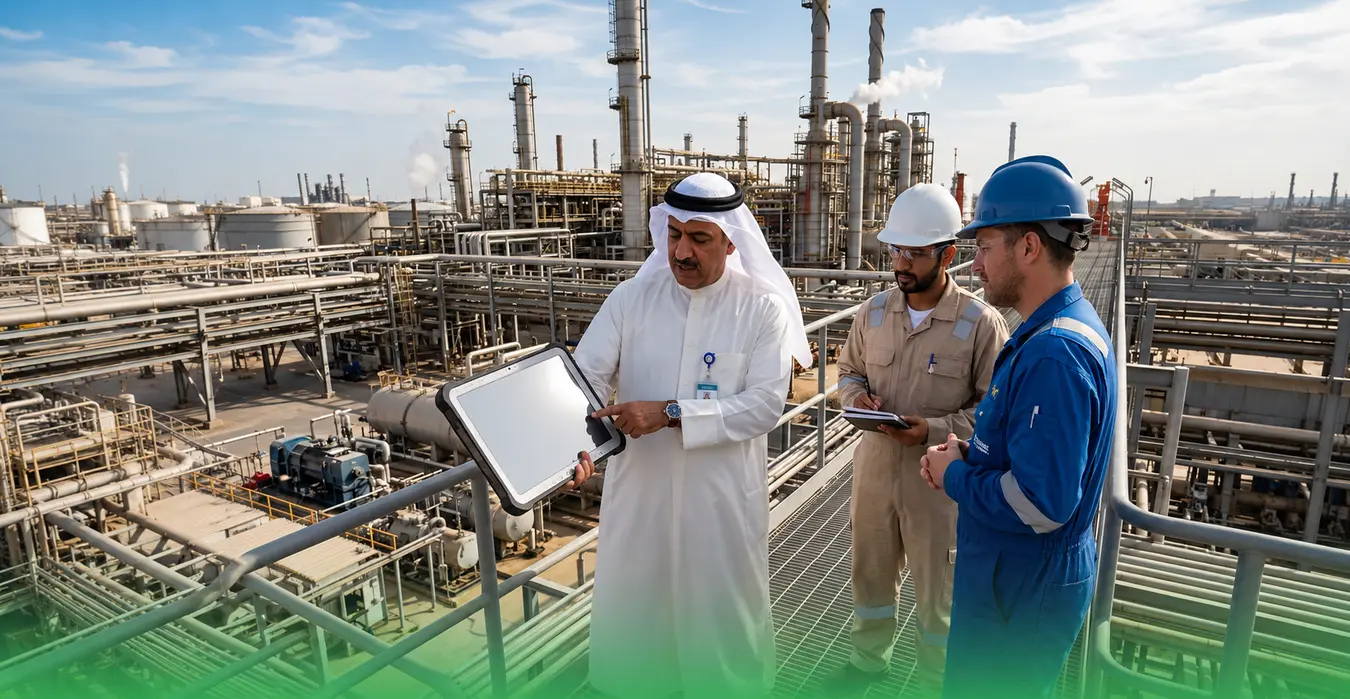
The environmental success of an industrial facility begins before equipment is purchased and before the design is finalized. Early decisions related to location, energy, materials, water, emissions, and waste will later determine the scale of required studies, measurements, controls, costs, and project schedule.
An Environmental Compliance Roadmap for Industrial Facilities in Kuwait helps the investor and project team organize requirements from the concept stage through operation, assign responsibilities, and prevent significant environmental gaps from being discovered after contracts have been awarded or construction has started.
The environmental roadmap for an industrial facility begins by reviewing the activity, site, and available alternatives, then identifying the required assessment and approval route and the information that must be prepared.
Environmental controls are then integrated into the design and contracts, while environmental management, monitoring, waste, and emergency plans are developed and implementation is monitored in the field.
Before operation, the project should review the readiness of:
The details vary according to the type of activity, location, scale of impact, and competent authority. Therefore, each project requires an early and project-specific definition of scope.
It is an implementation pathway that links project decisions with environmental deliverables throughout the project lifecycle instead of treating an environmental approval or study as a standalone document.
The roadmap defines:
There is no single roadmap suitable for every factory.
Materials, processes, energy requirements, emissions, water use, waste, and site sensitivity vary from one facility to another. Therefore, the roadmap should use customizable decision gates rather than a rigid checklist.
Define:
Both the expected operating scenario and the maximum scenario should be clarified.
Designing environmental systems based on an unrealistic average may result in inadequate:
Review alternatives that can reduce environmental impacts at the source, such as:
Opportunities for change are generally broader and less costly at this stage.
Review:
The availability of a plot of land does not necessarily mean that it is environmentally suitable for every type of industrial activity.
Baseline information, site visits, or measurements may be required to understand existing conditions.
These data help:
The type, size, location, and expected impacts of the activity determine the type of:
that may be required.
SSG’s Environmental and Social Impact Assessment service explains that screening helps determine the appropriate environmental deliverable and supports the approval process according to applicable requirements.
A requirements register should be prepared showing:
Do not establish a final submission date until the design and information affecting the assessment are sufficiently complete.
Collect:
The figures presented in drawings, tables, and specifications should be consistent.
Define:
Any significant assumption should be known and documented because a change in that assumption may require the environmental impact assessment and controls to be reviewed.
Recommendations from the environmental study should be converted into specific design requirements, such as:
These controls should appear in:
They should not remain only within an environmental report.
Conduct environmental design reviews at defined project stages and before procurement or construction documents are issued.
A general statement such as:
“The contractor shall comply with environmental requirements”
does not replace measurable technical requirements.
Include environmental requirements related to:
Where relevant, suppliers should be required to provide information related to:
Define contractor responsibilities for:
Contracts should also provide for:
Environmental requirements should be consistent with the project schedule and budget so that they can actually be implemented.
The Environmental Management Plan converts environmental aspects and obligations into:
Topics may include:
The plan should be customized to:
A generic plan that does not define areas, responsible persons, frequencies, and evidence is not suitable as a practical monitoring tool.
Site arrangements should be reviewed before work begins.
Then:
should be conducted according to the level of environmental risk.
Observations should be:
Design changes and construction-method changes should also be reviewed before approval if they may affect the environmental assessment or required controls.
This can be linked with SSG’s Environmental Supervision of Construction Projects to help ensure that study, plan, and contractual requirements are converted into documented site practices.
Identify:
Waste should be separated from:
Review:
Reviewing Safe Disposal of Solid and Liquid Waste helps establish a clear route from the point of generation to the appropriate receiving party while preventing:
Define:
Depending on the activity, the program may cover:
Monitoring points should be linked to:
SSG provides Testing and Analysis services covering air, noise, water, soil, and workplace environments.
The measurement scope should be selected to answer a specific environmental question and project requirement rather than simply to build a file.
Before introducing materials or operating equipment, conduct an environmental pre-startup review covering:
Review the final material list and compare it with what was previously assessed.
Construction observations that may affect environmental performance should be closed before operation.
Any significant change should be assessed before startup.
Plan to increase operating load gradually while monitoring critical indicators.
Define:
Operating conditions associated with each measurement should be recorded.
Do not rely on a single result to demonstrate stable environmental performance.
Monitor trends under representative operating conditions, investigate deviations, and adjust:
before moving to stable operation.
The project team should hand over:
Each obligation should have a defined owner after responsibility transfers to the operations team.
Establish:
Environmental compliance is not an event that occurs at facility opening.
It is a continuous management system that adapts to:
The owner:
The consultant:
The designer:
The contractor:
The operator:
No critical responsibility should remain unclear between parties.
Use a responsibility matrix showing:
Each deliverable should also be connected to:
For example, the design of a storage area should not be closed before the material and waste lists have been approved.
Common mistakes include:
Other mistakes include:
SSG can conduct an early project-scoping session, review the activity, site, and available information, identify the required environmental assessment pathway, prepare studies and plans, design monitoring and waste-management programs, and support environmental supervision and operational readiness.
This allows different environmental services to be linked within one roadmap with clearly defined deliverables and decision points.
The scope of service is determined after reviewing:
You can contact SSG before submission or contracting to help reduce rework and identify critical environmental information at an early stage.
Suppose an investor is planning a factory that:
At the concept stage, the team should not be satisfied with simply naming the industrial activity.
Instead, it should develop an initial balance covering:
and compare process and site alternatives.
This early balance reveals:
It also helps prevent the project from finalizing a design that cannot accommodate realistic environmental requirements.
After selecting the preferred alternative, a review should be conducted between:
to define deliverables and dependencies.
The consultant should not be asked to assess an emission source whose specifications have not yet been defined.
Similarly, a treatment system should not be procured before:
have been established.
Observations should be recorded in a design register, and their closure should become a condition before issuing drawings or purchase orders that would be difficult to modify later.
During construction, the readiness of each environmentally sensitive activity should be reviewed before it begins, such as:
Implementation should be documented using:
Any change in equipment or capacity should also be evaluated.
As operation approaches, a multidisciplinary team should conduct a pre-startup inspection and verify that:
During the first month of operation, actual data should be compared with the assumptions used in the study and design, including:
A difference should not automatically be treated as a failure, but it should be:
Operating, monitoring, maintenance, and training plans should then be updated, and actions should be closed before stable operation is declared.
Management should also maintain a decision register connecting each:
to:
This register helps prevent study requirements from being lost between design, construction, and operation.
It also allows the project to demonstrate:
The register additionally supports:
| Stage | Environmental Deliverable | Main Responsible Party | Decision Gate |
|---|---|---|---|
| Concept and site | Activity description, site review, and alternatives | Owner and development team | Suitability to continue with the site |
| Assessment and approval | Study/report, requirements, and controls | Consultant and owner | Completion of required data and approval pathway |
| Design and procurement | Controls incorporated into drawings and specifications | Designer and procurement | No incomplete environmental requirements issued |
| Construction | Plan, supervision, monitoring, and records | Contractor and consultant | Readiness of sensitive activities |
| Pre-operation | System, control, and training review | Project and operations teams | Permission to introduce materials |
| Commissioning | Measurements, trends, and closure of deviations | Operations and environmental team | Transition to stable operation |
It should begin during the concept and site-selection stage because decisions about:
will later determine environmental impacts, controls, and costs.
No.
The environmental study is only one part of the overall process.
Environmental controls must also be integrated into:
The initial information includes:
Baseline measurements may be required when there is a need to:
Commissioning tests the performance of:
under actual operating conditions.
It also provides an opportunity to correct deviations before stable operation begins.
Yes.
Requirements vary according to:
The roadmap should therefore be customized for each project.
If your project requires an environmental review, study, or compliance plan in Kuwait, you can contact SSG to review the requirements and determine the appropriate scope of service according to the type of activity, implementation stage, and competent authority.

Sorry, this entry is only available in العربية.
Sorry, this entry is only available in العربية.
Sorry, this entry is only available in العربية.