

Thursday April 9th, 2026
(العربية) هل تحتاج قياسات جودة الهواء داخل الموقع أم خارجه؟ وكيف تحدد برنامج الرصد المناسب؟
Sorry, this entry is only available in العربية.
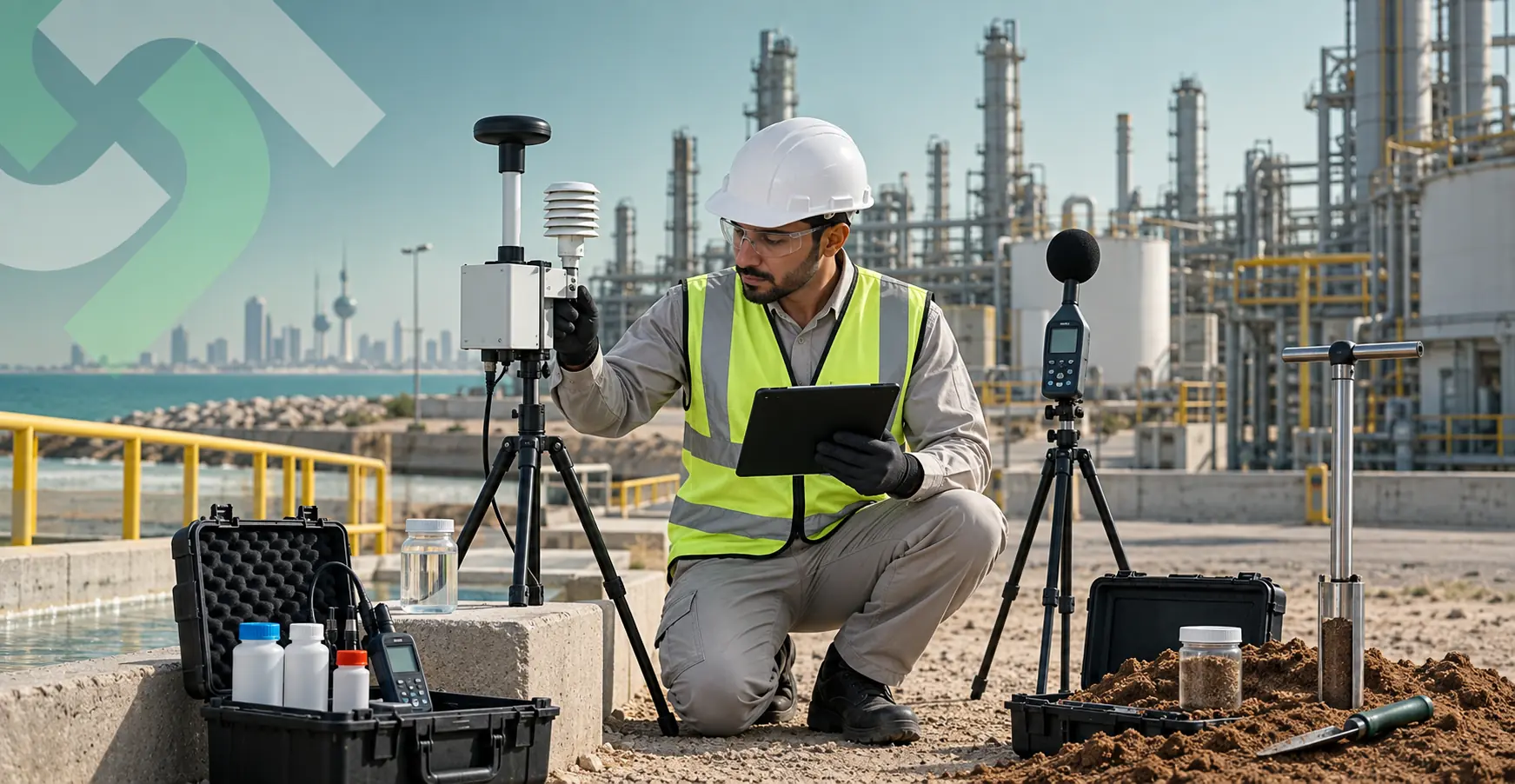
It is a written plan stating what will be measured, where, when, how, by whom and how results will be reviewed. It may cover ambient air, stationary-source emissions, noise, indoor workplaces, water, wastewater and soil according to the facility and its risks.
The program also covers objectives, sampling maps, operating and weather conditions, sample preservation, equipment calibration, quality control, comparison criteria and escalation when a deviation appears.
A suitable program produces data management can use to prioritise action, improve operations, review control effectiveness and support compliance. Measurements disconnected from risk may consume resources without answering the required question.
Requirements vary by sector, scale and location. The program should align with applicable Kuwaiti environmental requirements, the Environmental Management Plan and relevant authorities without assuming one frequency or parameter list for every activity.
Document production lines, materials, fuels, operating hours, emissions, discharges, storage and equipment movement. Cover representative normal operation and consider start-up, shutdown, maintenance and abnormal conditions where relevant.
Review nearby homes, workplaces, drainage, water and sensitive land. Wind, site drainage and soil characteristics help select locations that represent actual pathways rather than merely convenient points.
Choose parameters from the source: particles and gases for air, sound level for noise, physical, chemical and biological characteristics for water, and soil contaminants or properties where leakage, agriculture or construction is relevant.
Define source, background and potential impact locations. Air monitoring considers wind; noise considers boundaries and receptors; water considers inlet, outlet, pre-treatment and post-treatment points. Record coordinates and descriptions.
Frequency reflects source risk, process variability, requirements and previous results. Monitoring may be continuous, daily, periodic or event-based. Timing should represent real operation rather than unusually low production.
Specify sampling methods, containers, holding time, chain of custody, calibration, blanks or duplicates where needed, units and detection limits. Result quality depends on the full measurement process, not only the laboratory.
Define reviewers, trends and deviations, and when to repeat a measurement, investigate or open corrective action. Analyse trends against production, maintenance, weather and complaints.
| Facility | Potential measurements | Monitoring purpose |
| Combustion or stack sources | Emissions and ambient air | Review sources and pollutant dispersion |
| Water use or discharge | Water and wastewater | Monitor quality and treatment |
| Construction or equipment site | Dust and noise | Track site and surrounding effects |
| Materials or waste storage | Soil and water where needed | Detect potential leakage or contamination |
It can produce unrepresentative data, poorly located points, frequencies that miss change or tests unrelated to risk. Problems may be detected late, remediation costs can rise and operating or compliance decisions become harder to support.
Common errors include copying another facility’s program, changing points without records, ignoring operating or weather conditions, overlooking detection limits, relying on one result and storing reports without trend analysis.
| Facility situation | Suitable service | Objective |
| No monitoring program | Environmental needs assessment | Define media, parameters and locations |
| Unstable results | Targeted testing and analysis | Verify cause and trend |
| Operating facility | Audit and program review | Assess adequacy and compliance |
| New project or expansion | Impact study and monitoring plan | Predict impacts and build a baseline |
Look for sector experience, understanding of Kuwaiti requirements, sampling-plan capability and the ability to connect results with operations and risk. Request a clear method covering locations, parameters, frequency, quality and reporting.
Consultancy quality depends on understanding the activity and regulatory context. Monitoring supports clearer decisions and reduced risk, but scope follows detailed review and does not guarantee approvals or remove every risk.
SSG can assess facility needs, define media, parameters, locations and frequency, conduct testing and analysis, and connect results with risks and environmental management. Services include air and emissions, noise, workplace environment, water and soil according to scope.
Map processes, materials, emissions, discharges and waste, then identify environmental media and receptors. Select parameters, locations, frequency and quality controls according to risk and relevant requirements. Every measurement should answer a clear operating or environmental question rather than come from a generic list.
No. Scope depends on activity, impact sources, location and operating history. One facility may need air and noise monitoring, another water and wastewater, while soil becomes relevant where leakage or contamination is plausible. Initial assessment identifies proportionate measurements.
Locations follow the source, pollutant pathway and sensitive receptors. Wind direction, drainage, site terrain, boundaries and operating areas are considered. The design may include background, source, post-treatment and potential impact points, with coordinates and descriptions recorded.
There is no universal frequency. It depends on requirements, source risk, operating variability, site sensitivity and previous results. Monitoring may be continuous, periodic or event-based. Timing must represent operating conditions and should be reviewed when activities change.
Field measurement records parameters directly on site, such as noise or selected air and water readings. Laboratory analysis examines samples under controlled conditions. A program may need both, and reliability also depends on sampling, preservation, transport, calibration and chain of custody.
First verify sampling quality, equipment, units and operating conditions, then compare previous data and other locations. Targeted repeat monitoring or source inspection may be needed, followed by investigation and corrective action when a deviation is confirmed.
SSG provides testing and analysis according to project scope, including ambient air and stationary-source emissions, noise, indoor workplaces, water and soil. The program is defined after reviewing the activity, location, risks and available information.

Sorry, this entry is only available in العربية.

Sorry, this entry is only available in العربية.
An assessment of the impact of temporary generators on neighboring areas in...