

Monday March 2nd, 2026
(العربية) دليل تعبئة «استمارة التقييم البيئي» للمراكز الطبية والمستوصفات (شرح بند‑بند)
Sorry, this entry is only available in العربية.
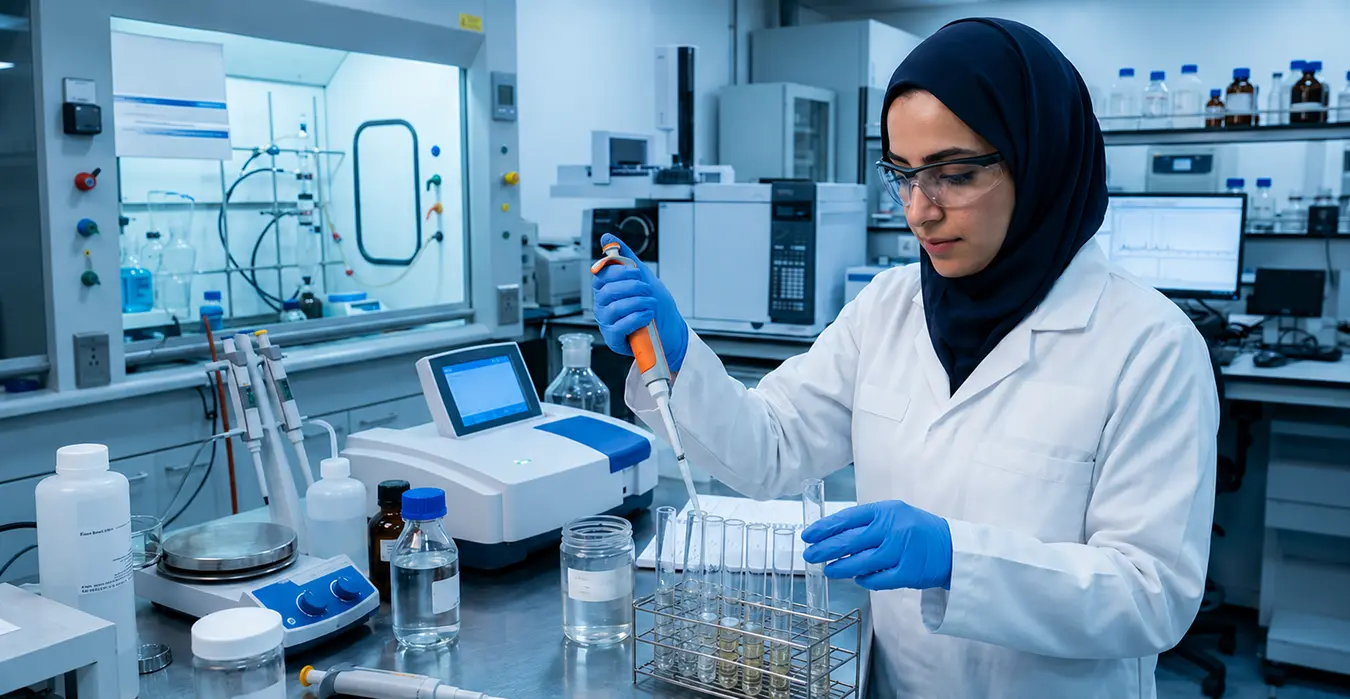
Industrial wastewater testing in Kuwait is a fundamental step for verifying whether wastewater complies with discharge or treatment requirements. It is particularly important for factory managers, environmental personnel, and operations teams, with the objective of obtaining documented data that helps demonstrate environmental compliance and reduce the risk of violations or rejection of the discharge.
The quality of laboratory results depends heavily on how the sample is collected and prepared before being sent to the laboratory. Therefore, understanding the required tests and proper sampling procedures helps facilities avoid resampling and delays in issuing technical reports.
Industrial wastewater testing identifies the characteristics of wastewater leaving the facility. It is required by environmental and operations personnel to determine whether the wastewater meets technical requirements and whether additional treatment measures are needed.
Wastewater composition varies significantly between industries. Therefore, the analytical program should be designed according to:
For this reason, many facilities rely on Environmental Testing and Analysis services to determine the appropriate analytical program and interpret results professionally.
Common tests assess the physical, chemical, and biological characteristics of wastewater. They help operations managers and environmental teams obtain a clearer understanding of water quality and potential pollution sources.
pH measures the acidity or alkalinity of the wastewater.
It helps with:
TSS measures the quantity of undissolved particles present in the wastewater.
It helps assess:
TDS measures the quantity of salts and other dissolved substances in the water.
It is used to evaluate:
BOD measures the amount of oxygen required for the biological decomposition of organic matter.
It is used to:
COD measures the total amount of chemically oxidizable substances.
It helps:
This is an important parameter for many industrial activities.
It helps:
Commonly tested heavy metals may include:
These are particularly relevant in:
These parameters are used to evaluate:
Phosphate is an important indicator when assessing the potential for nutrient enrichment of receiving water bodies.
These may include:
The analytical program should be selected according to the type of industry and the likely pollution risks.
The objective is to obtain useful information without conducting unnecessary tests.
| Facility Type | Common Tests |
|---|---|
| Food industries | BOD, COD, Oil & Grease, TSS |
| Metal industries | Heavy metals, pH, TDS |
| Chemical factories | COD, metals, ammonia |
| Treatment plants | BOD, COD, TSS, microbiological indicators |
| Petroleum industries | Oil & Grease, COD, metals |
Correct sample preparation improves the reliability of laboratory results and reduces the possibility of resampling.
This is particularly important for environmental and operations teams that require technically reliable reports.
Choose a point that represents the actual wastewater being assessed.
The location should be:
The sample may be either:
A grab sample is collected at one specific point in time.
It may be suitable when:
A composite sample is collected over a defined period.
It may be suitable when:
Sample containers should be:
Samples should be transported according to the applicable preservation requirements.
This may include:
The following should be recorded:
Avoiding the following mistakes helps speed up reporting and reduce the cost of repeat testing.
This may affect the integrity of the sample.
Some parameters can change quickly after collection.
This may result in the sample being rejected.
This may produce results that do not reflect actual operating conditions.
The results may provide an inaccurate picture of actual process performance.
A laboratory request form may include the following:
Interpreting laboratory results connects the analytical figures to the facility’s actual environmental performance.
This helps operations managers and environmental teams make data-based corrective decisions.
Each parameter should not be considered in isolation.
The assessment should also review:
For this reason, analytical results are often linked to Environmental Management Plans to ensure that required improvements are implemented and their effectiveness is monitored.
The work is led by Dr. Lina Hassan, who holds a PhD in Environmental Science and has more than 15 years of experience leading environmental impact assessments for energy and infrastructure projects across the Gulf region. She is accredited by the International Association for Impact Assessment.
Dr. Lina Hassan — Principal Environmental Consultant, PhD in Environmental Science, accredited by the International Association for Impact Assessment, with more than 15 years of experience delivering approved environmental impact assessments for clients in the industrial and infrastructure sectors in Saudi Arabia, the UAE, and Oman.
Our environmental impact assessment methodology follows the guidance of the ISO 14001 international standard and applicable local regulatory frameworks.
All field data is collected using calibrated equipment and documented through traceable chains of custody.
If you require Industrial Wastewater Testing in Kuwait, preparation of a sampling program, interpretation of laboratory results, or issuance of a professional technical report, the Sustainable Solutions Group team can support you throughout the process.
Services include:
For inquiries or to arrange a meeting:
90915984 – 22449089
or through the Contact Us page.
Answer: An Environmental Impact Assessment is a study used to evaluate how your project may affect air, water, soil, and communities.
If you are developing a factory, resort, road, or major development project in the region, you are likely to need one.
We manage the full process—from scoping through approval by the competent authority.
Answer: Most Environmental Impact Assessments take approximately 8 to 12 weeks, depending on project complexity and data availability.
We provide a written schedule at the beginning of the assignment and issue weekly updates.
No surprises.
Answer: Yes.
We have direct experience submitting and obtaining approval for studies with environmental ministries, municipal authorities, and international financing institutions.
We understand the requirements—and how to address them.
Answer: We do more than write reports.
We integrate with your project team, collect field data ourselves, and design mitigation strategies that can actually work in practice.
Our studies are designed for approval—and for implementation as well.
A single sampling error can produce misleading results that may expose your facility to regulatory or legal concerns. At SSG, we apply rigorous protocols for Industrial Wastewater Testing in Kuwait to help ensure that your reports accurately reflect actual conditions and address environmental authority requirements. Contact our experts today to support your facility’s environmental compliance.
Sorry, this entry is only available in العربية.
Sorry, this entry is only available in العربية.
Sorry, this entry is only available in العربية.